
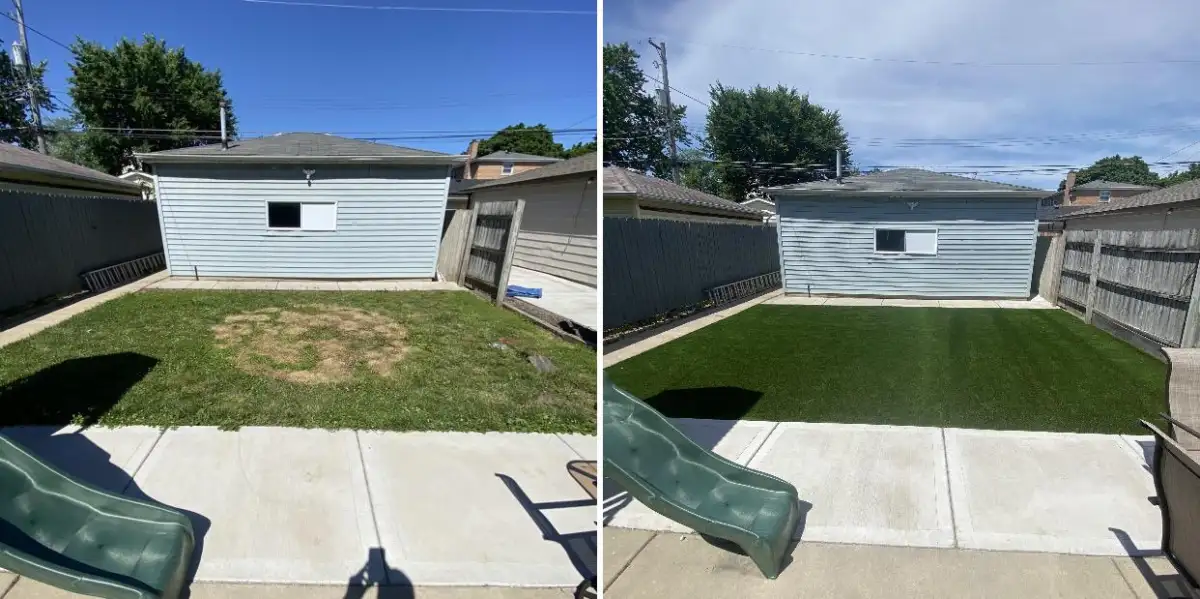
The best artificial turf is the product that fits the space, traffic, drainage needs, and appearance you want. A soft, tall sample is not automatically better than a denser, shorter option. Blade structure, thatch, backing, infill, and recovery all influence how the surface looks and behaves after installation.
Southwest Michigan yards add their own practical tests: lake-effect precipitation, freeze-thaw cycles, shaded side yards, sandy lakeshore soils, inland clay, dogs, patio transitions, and seasonal debris. A product should be evaluated as part of an installed system built for those conditions.
Great Lakes Synthetic Turf uses American-made turf products and helps homeowners compare options for lawns, pets, play spaces, and putting greens. The selected surface is installed over a compacted drainage base with secure edges, carefully planned seams, and the appropriate infill.
Sample test: Look at the turf outdoors, spread the fibers apart to inspect density and thatch, press down to see how the blades recover, and ask how the backing and infill support the intended use.
Match pile height and density to daily use
Pile height describes fiber length; density describes how closely those fibers are stitched. A taller pile can create a lush lawn look, while a dense medium pile may recover more readily in a busy family yard. Ask to compare samples under hand pressure and against the expected traffic pattern.
Blade shape also affects resilience and feel. The right combination depends on whether the surface is primarily decorative, used for play, crossed repeatedly from a patio, or shared with dogs. Product comparisons should reflect the actual yard rather than a showroom preference alone.
Read color and thatch in natural light
Mixed blade tones and a contrasting thatch layer can create depth that a single flat green lacks. View samples outdoors beside the home's plants, pavers, siding, and shaded areas. Color will read differently in full sun than it does under a covered porch or showroom lighting.
Thatch is the shorter, curled fiber near the base of lawn turf. It adds body and helps support the upright blades. The goal is not to imitate every natural lawn; it is to choose a surface that looks appropriate beside the property and retains that character after brushing and infill.
Check backing, drainage, and infill as one system
The backing anchors the fibers and lets water pass through the surface. Permeability only helps when the base below is compacted, graded, and connected to a clear drainage path. Infill supports the blades, adds ballast, and can be selected around lawn or pet-area priorities.
Ask how the proposed turf, infill, aggregate base, edge system, and seam plan work together. If dogs are the main use, review pet turf installation. If golf is the goal, a dedicated putting surface is built to different tolerances.
Artificial Turf Installation
See the statewide process, base preparation details, and service options.
Kalamazoo Turf Planning
Explore turf installation considerations for Kalamazoo properties.
Michigan Service Areas
Find your community and confirm service availability.
Separate product quality from installation quality
A strong turf product cannot compensate for weak grading, a shallow or poorly compacted base, unsecured edges, visible seams, or runoff that has nowhere to go. Likewise, precise installation should not begin with a product poorly suited to the way the surface will be used.
Compare complete proposals that identify the turf product, excavation, base material, compaction, edge restraint, seams, infill, access, disposal, and final grooming. For existing water problems, include drainage corrections in the scope rather than expecting the turf to conceal them.
Bring samples into the context of the property
Review samples beside the patio, beds, and house at different times of day. Share rough dimensions, the intended use, pet details, known water issues, and photos of gates, downspouts, trees, and hardscape edges. The site context often makes the best product choice much clearer.
- Compare pile height, density, blade shape, and recovery.
- View color and thatch outdoors in sun and shade.
- Confirm backing permeability and the planned drainage base.
- Ask which infill supports the intended lawn or pet use.
- Separate putting surfaces from landscape turf selections.
- Compare the complete installation scope, not the sample alone.
Account for seams, roll direction, and access
Turf fibers have a direction, and roll layout affects how color and texture read from the main viewing angle. The installer should also plan seams around the property shape and account for moving turf rolls and aggregate through gates or narrow side yards.
Choose the system you can evaluate clearly
Before approving a proposal, make sure the product name, intended use, base preparation, drainage approach, edge detail, seam plan, infill, and cleanup are all described. Clear selections make it easier to compare value and understand how the finished yard will be built.
Great Lakes Synthetic Turf serves Benton Harbor and communities across Michigan with artificial turf installation, synthetic turf installation, artificial grass installation, pet turf, putting greens, drainage work, hardscaping, landscape lighting, outdoor living, and landscaping. Request a free estimate through the contact page or call (231) 414-6011.
FAQ
What should homeowners compare in artificial turf samples?
Compare pile height, density, blade shape, thatch, color, backing, recommended infill, recovery after pressure, and intended use.
Is taller artificial turf always better?
No. Density, blade structure, infill, and traffic recovery matter alongside height. The intended use should guide the selection.
Why does artificial turf backing matter?
The backing anchors fibers and allows water to pass through. It must be paired with a correctly graded, compacted drainage base.
Do pet areas need a different turf product?
Pet areas benefit from permeability, strong recovery, comfortable fibers, suitable infill, and a base designed for regular rinsing.
How should artificial turf color be selected?
View samples outdoors beside the home's landscaping and hardscape. Mixed blade tones and thatch can create a more layered appearance.
Does the turf sample determine the whole installation quality?
No. Base preparation, drainage, seams, perimeter restraint, infill, and installation craft determine how the complete system performs.